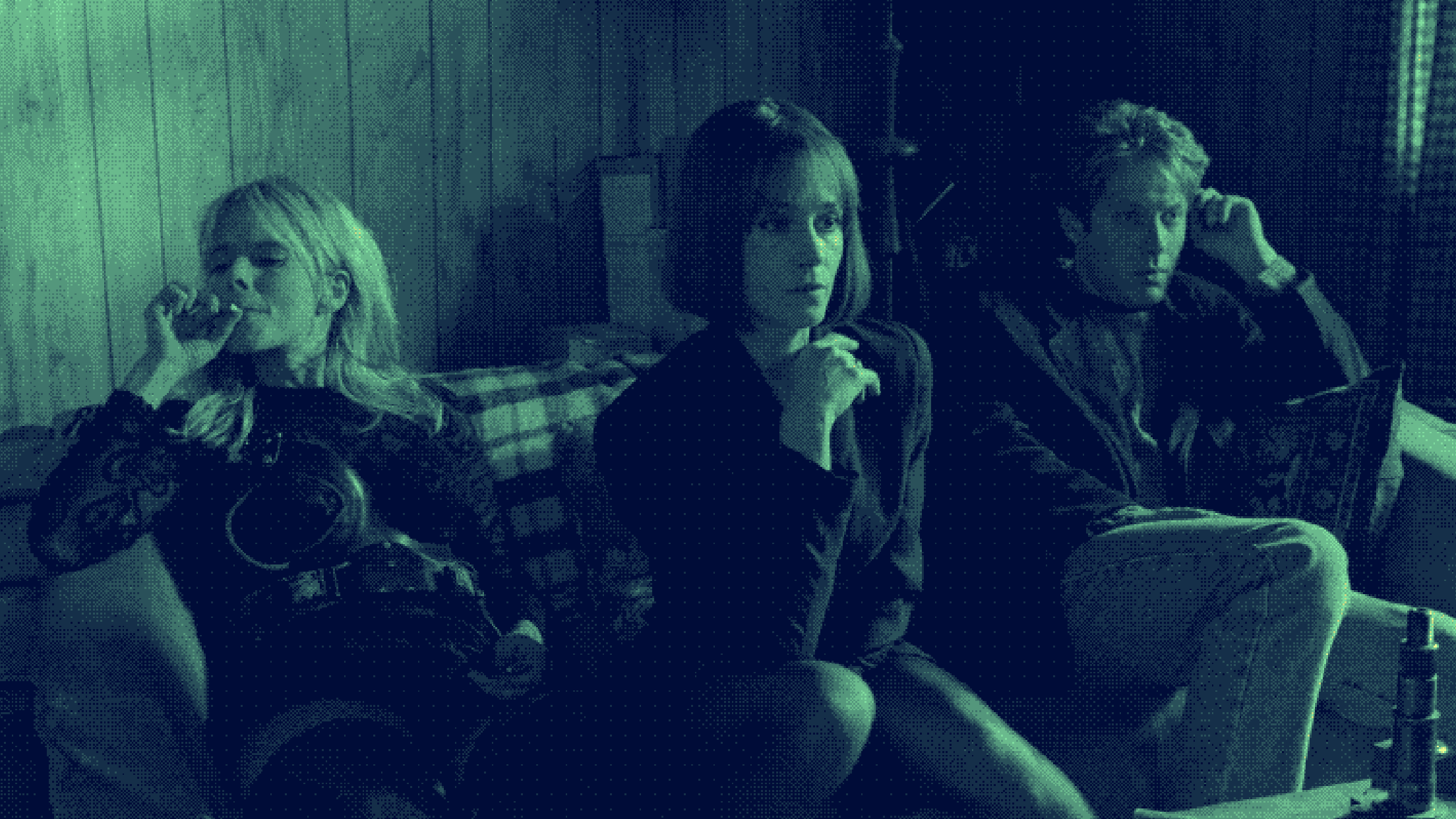
Crash
the religion of the collision
cronenberg adapting ballard, 1996. on the thesis where the body has been so anaesthetized by mediation that the only kind of touch it still registers is the kind that leaves a mark — and the religion of the collision that follows from there.
crash is the first great novel of the universe of simulation.
— baudrillard
early in cronenberg’s crash there’s a scene where catherine is in an aircraft hangar, blouse open, leaning against the wing of a small plane while a man works on her from behind. she’s not bored, exactly. she’s not anywhere. then a cut: james in his office, on the floor with a production assistant who is on top, who is also not anywhere. then a cut: catherine and james in bed, debriefing each other’s affairs, finding the details politely interesting, finding the bodies of strangers more available than the bodies between them. neither of them comes.
cronenberg makes this opening boring on purpose. the boredom is the thesis. for the next ninety minutes the film is going to demonstrate, with great patience and almost no music, what people who can’t feel sex anymore will do to feel something. then it is going to ask you which side of the screen you are sitting on.
the diagnosis#
ballard’s novel came out in 1973, partly on the back of an art exhibition he had staged in london where he crashed cars in a gallery, set up a topless model to interview the visitors, and watched what happened. the novel is the gallery turned inward. cronenberg adapts it in 1996, after dead ringers and naked lunch and m. butterfly — after he has stopped doing body horror about parasites and started doing it about everything else. the gap between novel and film is twenty-three years. the world cronenberg’s adaptation lands in is post-everything in a way ballard’s original could not yet quite be.
baudrillard’s reading of the novel, in simulacra and simulation, is that crash is the first great novel of the universe of simulation. he means: a world so thoroughly saturated by image and technology that the gesture and the thing it once stood for have become indistinguishable. sex was once a gesture toward an experience. now it has been mediated, scripted, rehearsed by pornography and fashion and advertising and every available surface, until the gesture has eaten the experience. the lovers in the opening triptych are not having sex. they are performing the cultural shape of it. they go through the moves because the moves still exist; the inside of the moves does not.
something has to puncture. the only thing left in a world that thorough is a thing the world cannot pre-script. the crash, in this reading, is what registers because it is the one event the system cannot anticipate. impact is the one thing left that the body still actually responds to. the wound is the one thing left you cannot photograph yourself into.
cronenberg’s film does not argue this. it acts it out.
the body#
cronenberg’s body horror up to 1996 is mostly about the body as invaded. shivers, 1975: aphrodisiac parasites colonize an apartment block. rabid, 1977: a skin graft produces a phallic stinger in marilyn chambers’ armpit. the brood, 1979: nola’s rage gestates externally as a small brood of murderous children. videodrome, 1983: the tumor as television set. the fly, 1986: seth brundle’s slow molecular reorganization into something else. dead ringers, 1988: the body as a thing to be re-engineered with custom-built gynaecological tools. naked lunch, 1991: the body as a typewriter, an insect, a hallucinated host.
the through-line is: the body is the site where the outside writes itself in. infection, transformation, doubling, reproduction — the body is what receives.
crash is different. nobody in crash is infected. nobody mutates. there is no parasite, no fly, no brood. the body in crash is the body, the body you came in with, in the cars, on the highways. what changes the body is collision — exterior, instant, mechanical, almost banal. there is no creature on the other side of the rupture. there is just the wound, and what the wound now means.
this is, i think, why crash is the cronenberg film people don’t want. shivers gives you the parasite to blame. the fly gives you brundle’s pathos. crash gives you no monster. the system that produced the bodies in the film is the same system that produced the bodies in the audience. the audience is being asked to recognize itself, without a metaphor between it and the recognition. people don’t like that.
the wound#
if the body is reconfigured by collision, then what was the body for? if the orifices are no longer where the desire is, where did the desire go?
the film’s answer, slowly and with a stillness that is a little terrifying when you notice it, is: the wound.
james meets gabrielle at vaughan’s flat. she is in a full-length leg brace built into the fabric of her leather dress. the brace is engineered with a slit at the back to access her, and the dress is engineered around the brace. she walks like a thing built out of two collisions, and she is beautiful in a way the rest of the film hasn’t shown you yet. they end up in a parked car. james reaches under the dress, finds the scar tissue running along her thigh — the place where the brace meets the body. he traces it. she lets him. the scar is being approached the way the body, earlier in the film, isn’t being approached. it’s the first scene of actual want in the entire movie.
cronenberg does not eroticize the scar as a fetish object. the camera does not linger pornographically. it isn’t about kink. the scar is being treated, with anatomical clarity, as a new orifice. the wound is the new place where penetration becomes available. ballard’s novel is even more explicit on this — the prose returns again and again to the structural rhyme between cicatrix and vulva, between bone protrusion and genital architecture. cronenberg’s version is more clinical, more interior, but the same theology is running.
later: vaughan and catherine in the back of his lincoln, in the carwash. the camera is in the front seat with james, who is driving. behind him, in the rear-view, vaughan is on top of his wife. what you can see most clearly is the bruise vaughan is producing along catherine’s hip. the next morning james is tracing the bruise along her side. he kisses it. he licks it. the licking is the most husbandly moment in the film. the bruise is being adored.
what is being adored is the proof that something happened to her body. proof that the body still touched something, that something still touched it back.
if there is one sentence i would use to describe what crash is about, it would be this: the body has been so anaesthetized that the only kind of touch it still registers is the kind that leaves a mark.
the cult#
a small group of crash survivors gathers around vaughan. seagrave, helen remington, gabrielle, eventually james and catherine. they are not a cult in the cinematic sense — no robes, no doctrine, no leader’s first name spoken in reverent tones. but they have all the structural features of one. shared trauma as initiation. ritual as the only available activity. a charismatic at the center who is running a project that is, in his own words, an iconography of the wound.
vaughan stages crashes. he is meticulous. the first big set piece is his restaging of james dean’s 1955 spyder crash — vaughan playing dean, seagrave playing rolf wütherich, a stunt driver in a fifties ford playing the donald turnupseed role. they perform it in front of a small night-time audience. police break it up. the audience is small enough that the question of “audience” almost dissolves into “congregation.”
the second restaging — jayne mansfield, 1967 — never happens onscreen. they’re planning it when vaughan dies.
what is this? what is the cult around? cronenberg, again, does not moralize. the cult is around the only experience the world still allows to be unscripted. the cult is around the church of the collision. these people have organized their lives around the one phenomenon late capitalism cannot quite repackage, because it happens too fast and breaks too much.
the structure of the repetition is, i think, lacanian. there is a name for what people do when they have encountered a thing they cannot symbolize: they don’t repeat to master, the way the freudian formula has it. they repeat to circle. the crash, for everyone in the film, is the encounter with the real — the thing that cannot be brought into language and therefore has to be approached, again and again, through the only language left, which is the body. vaughan’s collection of crash photographs and casts and 16mm test footage is the iconography of an event he cannot put into any other shape. james, after his own collision, does not heal; he gravitates. he gravitates toward what hurt him because the hurt was the one thing that registered. helen remington, who lost her husband in the wreck with him, is the only character whose grief gets named on screen, and even she, by the airport-parking scene a few weeks later, has converted it into a kind of professional curiosity. catherine’s monologue in the airport — listing the men around them, imagining their bodies in collision, getting james hard inside the car while she lists them — is the same psychology in transit. the only thing left that can be desired is the rupture. the body has been emptied so completely that nothing else lands.
and crucially, the cult is not transgressive in the way the nineties wanted transgression to be. there are no parties. there is no excess. the cult is mostly quiet. mostly waiting. their pornography is grainy crash-test footage. their liturgy is the photograph and the cast. they are not enjoying themselves. they are circling the only available rupture.
form#
howard shore composed the score for six electric guitars, three harps, and three woodwinds. the guitars are detuned. the harps are processed. the score does not sound like a score. it sounds like the inside of a car — coiled, metallic, low, mechanical at intervals. there is no swell. there is no theme that returns to console you. shore is the right composer for cronenberg because shore understands that the music of a film like this cannot ask the audience to feel anything the film itself has stopped feeling. the music has to be a piece of the diagnostic instrument.
peter suschitzky’s photography is blue and chrome and the bleached fluorescent of a parking garage at 3am. the toronto highways are shot the way porn photographs the body — from below, from angles that make the surface bigger than it is. infrastructure as pornography. this is consistent with the thesis. the film is showing you, frame after frame, that the things the world has placed in front of the body — the cars, the freeways, the lights, the underpass — have become the things the body has begun to want, because the body has been left no one and nothing else.
deborah kara unger’s performance as catherine is so still it becomes a kind of acting in itself. she is barely moving in the frame for most of the film. she is barely inflecting a sentence. she is letting the camera find her instead of presenting herself to it, and that refusal is the performance. there are actors who fill the frame and there are actors who let the frame find them. unger in crash is doing the second thing, and almost nobody in 1996 was. elias koteas as vaughan is charismatic without doing any of the things conventional charisma does — no big speeches, no aggression, no wattage. he is just always slightly the most settled person in the room, which when you are in a room full of people who are not settled is a form of leadership.
pacing. this is the thing the film does that almost nobody else does. every scene is at the same level. there is no escalation toward a climax. there are no money shots. there is no cathartic release for the audience. the film refuses, structurally, to give the viewer the very thing the characters in the film have lost the ability to receive. you sit in your seat and watch a film whose form has been designed to not satisfy you, in the exact way the world the characters live in does not satisfy them. you don’t feel released by the ending. you feel, more accurately, named.
the last line#
the ending: james has been chasing catherine on the highway. he means to clip her car, recreate one of vaughan’s choreographed collisions, do to her what the cult would have wanted done. he succeeds. her car rolls down the embankment and lands on its side in the long grass. james gets out of his own car. he walks down. he kneels by the wrecked door, finds her crawled partway out, alive. he asks if she is all right. she says she thinks she is. he gathers her in his arms.
then the line: “maybe the next one, darling. maybe the next one.”
it is the saddest sentence in cronenberg’s filmography. it is sad in the way a thing is sad when nothing about it pretends to be anything else. they have not, after all this, achieved the wound that finally makes them feel. they are going to keep trying. they are going to keep trying together. the love in the line — and there is love in the line — is the love of two people who can only meet each other on the far side of a collision.
cronenberg cuts to black on it. no closing montage. no music swell. just the line, the embrace, and out.
the most common thing said about crash by its 1996 detractors was that it was nihilistic, that it had no morality, that it celebrated the wreckage. i think the people saying that were responding accurately to the surface of the film and missing the line. the line is a love line. it’s a tender line. it isn’t celebrating anything. it’s pointing, with a steady hand and a great deal of pity, at where two people who have been completely emptied out have managed to find each other.
it is the most catholic thing cronenberg ever filmed. the wound as the meeting place.
what’s left#
the 1996 controversy was always about the wrong thing. westminster council and the daily mail and the lions gate cuts and the cannes jury hostility — all of them were arguing about whether the film celebrated wreckage. that was never the question. cronenberg wasn’t selling a lifestyle. he was naming a condition.
the condition: a world that has scripted desire so completely that desire has begun to look for the one place the script cannot go — the wound, the rupture, the place where the body finally interrupts the surface. cronenberg made the film in 1996 about a world that, in 2026, has only become more saturated. the smartphone had not even arrived yet. instagram had not. tinder had not. the entire pornographic infrastructure that has since trained a generation to perform the gestures of intimacy at the cameras pointed at themselves — that wasn’t there yet. crash was a diagnosis ahead of the diagnosis.
i think this is why the film keeps coming back. it isn’t that the film aged well. it is that the world aged into the film. the thing it was naming has, in the thirty years since, become more obviously the thing it was naming. the only revisions a reviewer would make to it now would be to update the technology. the body in front of the screen, looking for any rupture that still registers, is the same body.
late in his life ballard, asked about crash, said something to the effect that he had written it as a cautionary tale, and no one had read it that way. and then a beat. and then: that may be the most cautionary tale of all.
// Discussion
Comments are powered by GitHub Discussions via Giscus. Sign in with your GitHub account to add a reply, or discuss on X.